
Commercial guide
What happens to the sprinklers and fire alarm during a commercial strip-out?
They stay in service unless the sprinkler and fire alarm contractors take part of a system out of service under the building's fire safety plan. Any impairment is coordinated with building management, usually with a fire watch in place until the system is restored.
- Fire protection
- Strip-outs
- Occupied buildings
MetroPoint Demolition planning guide · Published 2026-09-28. Confirm property-specific requirements with the responsible authority and qualified project professionals.
Identify everything in the ceiling first
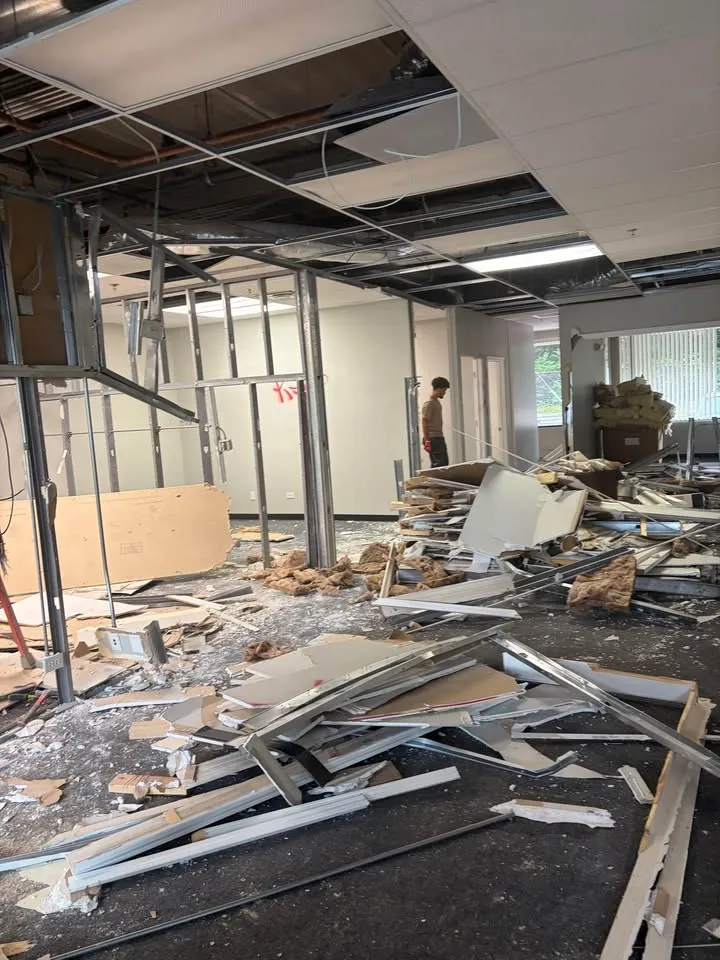
Before any ceiling comes down, the crew identifies sprinkler heads, branch lines, fire alarm devices and wiring in the work area. The ceiling is opened carefully, starting in a small section, so heads and devices are located before they can be hit. Marking them keeps everyone aware of where they are as the work moves.
Ceiling investigation is treated as a distinct first step rather than something discovered while the main removal is underway. A small controlled opening lets the crew see sprinkler branches, heads, fire alarm wiring and devices before a larger area of grid or board is disturbed. From that opening, visible routes are followed and compared with drawings or information from building management. The locations are then marked on the ceiling or a site sketch so everyone working overhead knows where services are likely to cross the work area. This is especially useful where previous tenant work has moved a detector, added a branch or left abandoned cabling among active systems. The crew distinguishes fire protection from ordinary electrical and communications wiring instead of treating every cable in the cavity alike. Ceiling material is lowered near identified services, never pushed upward into pipe or device housings. Ladders and mobile equipment are positioned with clearance for exposed heads, and debris is moved away before the next bay opens. If an unexpected branch or device appears, work pauses locally until building management and the appropriate contractor confirm its status. This deliberate mapping takes time at the beginning, but it avoids a sprinkler discharge, damaged alarm circuit or building-wide disruption later. It also gives the fire protection contractors a clear view of what must remain, what needs adjustment and when any coordinated impairment is actually necessary.
Protect heads and never hang from sprinkler pipe
Sprinkler heads can activate if struck, and pipe is not designed to carry other loads. On a strip-out:
- Heads are protected with guards where they are exposed
- Nothing is hung, tied or rested on sprinkler pipe
- Ladders and lifts are positioned clear of heads and lines
- Debris is lowered carefully in areas with exposed piping
Draining, capping or relocating a branch
When the new layout needs sprinkler branches changed, the sprinkler contractor does the work. They drain the affected section, cap or relocate branches and return the system to service. The demolition crew does not cut, cap or move sprinkler piping.
Disabling devices in the work zone
Dust from demolition can trigger smoke detectors. The fire alarm contractor may temporarily disable or cover specific devices in the work zone, following the building's fire safety plan and coordinated with building management. The rest of the system stays active for the building.
Fire watch when a system is impaired
If any part of the sprinkler or fire alarm system is out of service, the building's fire safety plan usually requires a fire watch: a trained person patrols the affected area to watch for fire and raise the alarm. The fire watch stays in place until the system is fully restored. Our guide to fire-rated walls during interior demolition covers the other side of fire protection during a strip-out.
Restoring everything before handover
Before the space is handed back, the sprinkler and fire alarm contractors return every impaired section to service and confirm it is working. Covers come off detectors, guards come off heads and building management is notified that the impairment has ended.
How MetroPoint coordinates this
MetroPoint identifies fire protection in the ceiling during the site walk and plans the office or commercial strip-out around it. We coordinate impairments with building management and the sprinkler and fire alarm contractors, protect heads during removal and confirm systems are back in service before handover.
Primary planning references
Frequently asked questions
- Can the demolition crew remove sprinkler heads?
- No. Sprinkler heads, branch lines and piping are handled by the sprinkler contractor. The demolition crew protects them and works around them. If the new layout needs heads moved or removed, the sprinkler contractor drains that section, makes the changes and returns it to service under the building's procedures.
- What is a fire safety plan?
- It is a building's documented plan for fire protection and emergency response, including how fire protection systems are maintained and what happens when they are out of service. Building management follows it for any impairment. Contractors working in the building are expected to work within it and coordinate with management.
- Why would the fire alarm be disabled during work?
- Demolition creates dust that can set off smoke detectors, causing false alarms and evacuations. To prevent that, specific detectors in the work zone may be temporarily disabled or covered by the fire alarm contractor. The rest of the system stays active, and a fire watch may be required while those devices are out.
- What happens if a sprinkler head is hit?
- A struck head can discharge, releasing water until the system is shut off. That is why heads are identified and protected before ceilings come down. If it happens, the crew notifies building management immediately so the sprinkler contractor can shut off and repair the section.